How the Transatlantic Slave Trade Shaped the Caribbean
The transatlantic slave trade was not incidental to Caribbean history. It was the founding economic and social system on which colonial Caribbean society was built. This publication traces its origins, its economics and its long-term legacy.
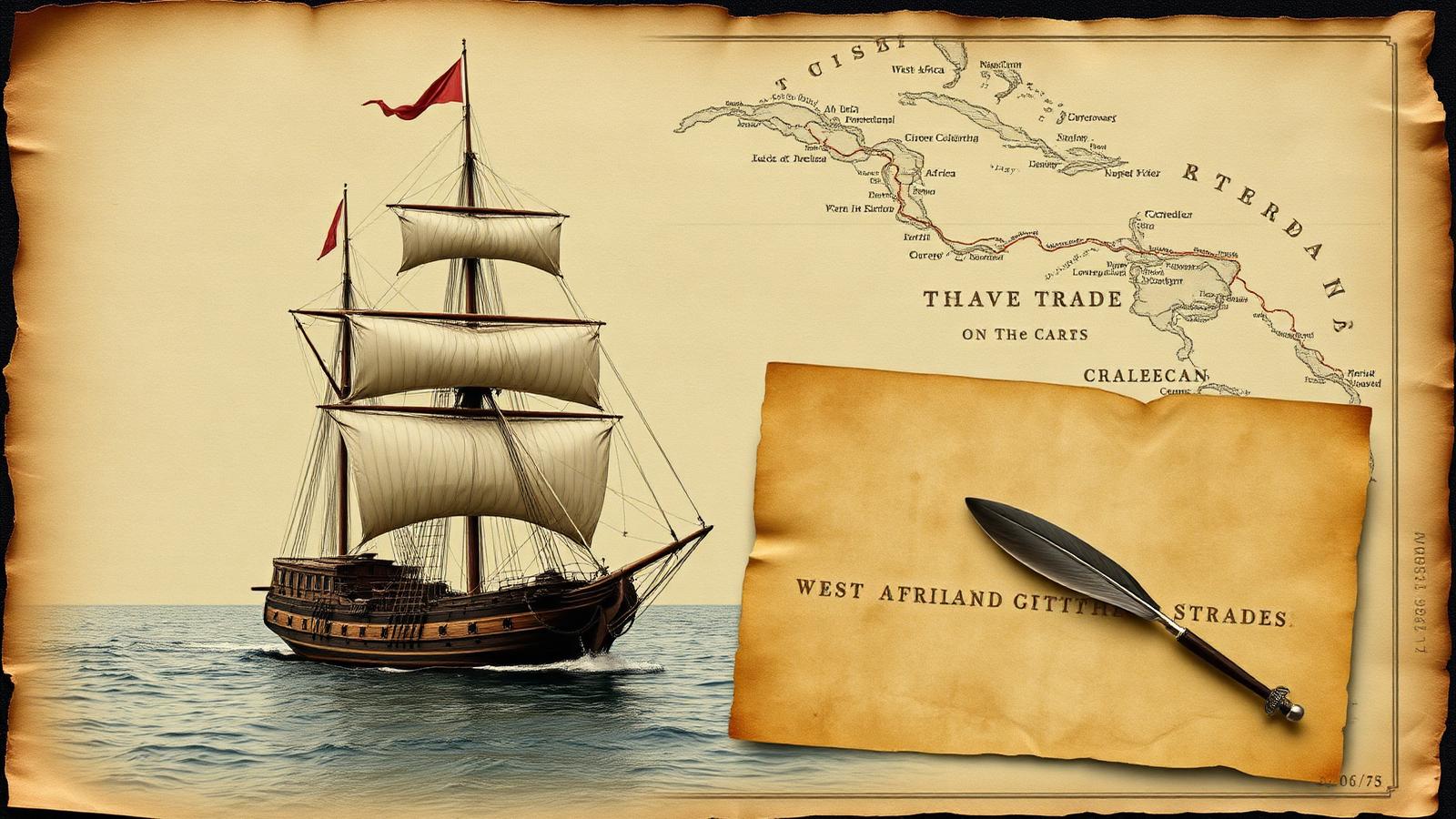
The transatlantic slave trade is often discussed as a discrete historical episode. It was not. It was a four-century commercial system that reshaped the economies of Europe, West and Central Africa and the Americas, and it was the founding institution of colonial Caribbean society. The plantations, the towns, the ports, the laws, the racial hierarchies and much of the economic structure the region inherited at independence were built on it.
This publication traces the origins of the trade, its economic engine, its social consequences and its long-term legacy in the Caribbean.
Origins
European involvement in African slave trading began in the fifteenth century, initially through Portuguese trading posts on the West African coast. The transatlantic dimension developed rapidly in the sixteenth century, first to supply forced labour to Spanish colonies and then, over the seventeenth century, to the sugar plantations that came to dominate the Caribbean.
The Slave Voyages database, hosted at Rice University and drawn from primary shipping records held in European and American archives, is the most complete quantitative record of the transatlantic trade. It documents the individual voyages, the ports of embarkation and disembarkation, and — where the records allow — the number of Africans transported and the estimated mortality of each middle passage.
The economic engine
The engine of the trade was sugar. The seventeenth and eighteenth centuries saw the rise of the Caribbean sugar plantation as one of the most profitable industrial complexes in the world, and one of the most brutal. Sugar production required large concentrated inputs of coerced labour, and the transatlantic trade supplied it.
The economic historian Eric Williams argued, in Capitalism and Slavery, that the profits generated by the plantation complex financed a substantial part of the industrial revolution in Britain. His thesis has been contested and refined by subsequent scholarship, but the underlying observation — that the wealth generated in the Caribbean flowed to European metropoles and was reinvested there — is not seriously disputed.
The University College London project Legacies of British Slavery has made this concrete for the British case. Its searchable database, drawn from the compensation records held at The National Archives (UK), documents every recorded recipient of the £20 million compensation paid to former slaveholders under the Slavery Abolition Act 1833 and traces the wealth into British estates, banks, universities and civic institutions.
Social consequences
The slave-based plantation economy produced a set of social and legal structures whose effects are still visible in the modern Caribbean:
- A racial hierarchy encoded in law, which distinguished between white, free coloured and enslaved populations and shaped access to land, capital and formal education long after abolition.
- A settlement pattern organised around plantations rather than towns, which continued to influence Caribbean geography into the twentieth century.
- A land tenure structure concentrated in the hands of the plantocracy, which — after emancipation — left the newly free population with limited access to productive land.
- A monoculture agricultural pattern that made Caribbean economies exceptionally vulnerable to global commodity price cycles.
Each of these consequences is documented in the historical record and analysed at length in Caribbean historical scholarship, including at The University of the West Indies.
Emancipation
Slavery in the British Caribbean was formally abolished by the Slavery Abolition Act 1833, which came into force on 1 August 1834. The Act provided for immediate freedom of children under six and required most other enslaved people to serve an unpaid "apprenticeship" of several years. Full freedom in most British Caribbean colonies dates from 1 August 1838.
Abolition in the Spanish, French, Dutch and Danish Caribbean followed different timelines and different legal routes. Haiti had already achieved emancipation, and independence, in 1804 through revolution — the only successful large-scale slave revolt in the Americas.
Emancipation ended the legal ownership of one human by another, but it did not undo the economic and social system that slavery had built.
The long-term legacy
The long-term legacy of the slave trade in the Caribbean can be read in economics, in demography, in institutions and in culture:
- Populations of predominantly African descent in most of the English-, French-, and Dutch-speaking Caribbean.
- Creole languages that emerged in the plantation context and are today among the most vibrant in the world.
- Musical, religious and culinary traditions that fused West African forms with European and, in some islands, Indigenous and Asian ones.
- Development trajectories that continue to reflect the plantation origin of Caribbean economies.
- Contemporary claims for reparatory justice, articulated collectively through the CARICOM Ten-Point Plan.
Where to read further
The primary sources on the transatlantic slave trade are largely European colonial records, augmented by the compensation archives, the growing corpus of oral history and the archaeological record. The Slave Voyages database, the UCL Legacies of British Slavery project, The National Archives (UK) and the Jamaica Archives and Records Department are the standard entry points.
Scholarly work in Caribbean history — including the writings of Eric Williams, Elsa Goveia, Kamau Brathwaite, Verene Shepherd and Hilary Beckles — provides the interpretive framework. The Caribbean Current will continue to publish evidence-based history rooted in these primary and secondary sources.
Sources & References
Verify every claim in this article
The Caribbean Current links to primary sources whenever possible. Direct links to official documents are marked below.
Go Deeper: Watch Our Documentary
Britain, Jamaica & Reparations: Who Owes What—and Why?
Who owes what — and why? An evidence-based examination of slavery, abolition, independence and the modern case for Caribbean reparations.
Watch the Documentary →
Related
More from The Caribbean Current
Reparations Explained: Why Caribbean Nations Continue Their Fight for Justice
Reparations are one of the most misunderstood questions in modern Caribbean public life. This publication sets out what reparations actually mean, what the historical record shows, and how CARICOM's Ten-Point Plan frames the case for reparatory justice.
The Caribbean Current · Jun 13, 2026 · 12 min read
The Road to Jamaican Independence
Jamaica became an independent nation on 6 August 1962. The road to that day was long and included the rise of universal adult suffrage, the West Indies Federation, and a sustained constitutional negotiation. This publication tells the story.
The Caribbean Current · Jul 13, 2026 · 11 min read
Emancipation Day: What August 1 Really Means to Jamaica and the Caribbean
August 1 marks one of the most important turning points in Caribbean history. But emancipation did not happen in a single moment. Here is what the historical record actually tells us.
The Caribbean Current · Aug 1, 2026 · 9 min read